Zootropolis:
Zootropolis (2016) is a fast paced children's animation which follows the story of a bunny who becomes the first to graduate from the police academy, in a civilised world where humans play no part. One of the main themes which becomes present across the film is evolution, and how remarkable it is for the character Judy Hopps to by-pass the innate biology of her species to defy all possibility of becoming a successful bunny cop.
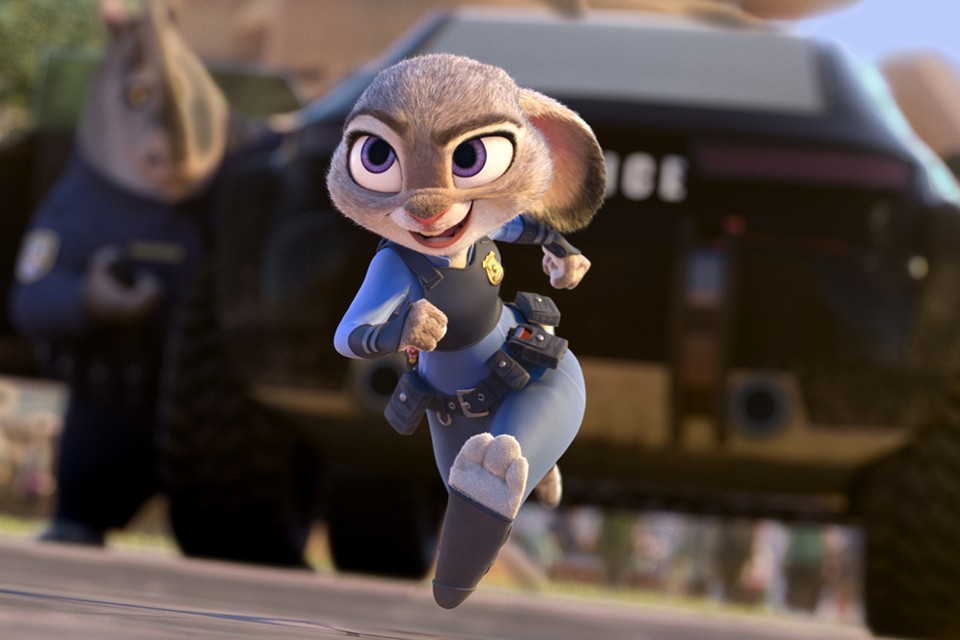 The children's animation however is extremely political, and incorporates many elements of American topics such as immigration, and the Donald Trump campaign. Although the politics within the film are somewhat too extreme for convention, the depth of the story line is more aimed at the adults taking them. The fast paced story which is quickly contradicted by the sloths, is one which grasps the attention of the audience and retains it throughout, whether this is through the witty humour or the more harder hitting topics, the animation is one which has been highly accredited for its incorporation of so many world issues whilst at the same opposes the reality of the food chain, whereby animals in the wild don't get along unlike in the film.
The theme of following your dreams which is portrayed in most of Disney's films is one which develops an emotional connection to the characters, and is an important trait of a children's film, whether animated or not. These types of messages are the ones in which the children will understand and be able to take from and relate to in their lives, which is why it is essential they are constructed in the right way. By presenting more adult topics with humour based jokes, the film gently exposes the target audience to the real world, whilst watching a virtual 'Zootopian City'. This subtle technique is very cleverly mastered and has been praised by not only film critics but also its custom of the audience.
This film conveys many emotions throughout, mainly positive, which is why for our 2 minute and 5 minute drama we have decided to result in a more upbeat emotion because we feel it can be appropriate and more understandable for a wider range of ages.
Short Film
Happiness - 'All Apologies'
The short Happiness 'All Apologies' is a beautifully executed film which concentrates on the raw emotion of happiness through the contradicted feelings of heartbreak and sadness. The film focuses upon an elderly woman who dances with her partner on the dance floor. Until the very end we as the audience aren't aware that the elderly lady who was dancing with her husband is in fact imagining the whole thing, and results at the end of the film is dancing alone on the dance floor.

As the film progresses, onlooking characters reach out to the lady in different ways, some whom are angry, some who are upset and some who look very disturbed and uncomfortable. Due to the audience seeing everything from the elderly lady's point of view, we as the viewer cant make reference to the out-paw of different emotions which create conflict throughout.What makes this piece so effective is the simplicity of the lighting, the setting and the song. Less is more in this case, and the film highlights evidently how to create such raw emotions from a simple context which in turn creates mixed reactions and leaves us with no answer to what actually happened to her or what we perceive to be her husband.
The long takes allows us as the audience to gain some form of understanding from the surroundings, but ultimately reflects confusion. These particular shots are extremely effective because they create a audience character relationship which we can empathise with so well at the end. The long takes create a sense of involvement because of the realistic approach taken within the cinematography, and the use of sound is extremely significant.
The dim lit room, which looks to be in a community hall portrays the emotions of sadness and heartbreak well. The contrast of emotions we are presented with throughout is something which is simple but extremely effective. The colour grading plays a huge part in the mood of the film, and allows the elderly ladies emotion of happiness shine through the darkness. Although an anamorphic lense was used to capture the "cinemtatic appeal" Adam Berg the director made sure that in post production the picture was even darker to ensure the tone of the film was obvious to the audience. He expressed in an interview that there was no shot list on set and that he just went with his 'gut feeling' as it was a last minute project which was shot after a day of filming a television advert.
Berg stated in an interview that the film was shot in one day, and on location the director cast the general public as actors due to the raw nature of their reaction to the concept of the film. He stated "I wanted everyone to simply react to the situation as it unfolded. I felt is was important for them to just do it without knowing what to do next.”
 The use of dialogue is important to many films, but what makes this film so unique is that there is none throughout the entire film, yet we connect so deeply with the emotion on screen. The song which is used across the whole film is slow and distressing which contradicts the happiness the female displays on screen as she dances away almost under the moonlight of the spotlight.
 The reason as to why this film is such a huge inspiration for ours is because of how the emotion of happiness is conveyed. The film is artistically portraying the emotion of happiness through such a heart wrenching moment in one woman's life. It could be analysed as how she has come to terms with the grief of his death, or she in fact could be imagining everything in her last few breaths before she joins him. Whatever the approach the filmmaker had towards the reasoning behind the dance in the first place is something else that adds to the simple and effective narrative.

No comments:
Post a Comment